Best Claude Code Skills for Cloud Infrastructure [2026]
We read 10 cloud infrastructure skills and scored five out of 50. Terraform state migration and Cloudflare's 12 Workers anti-patterns tie at 43/50.
We installed 10 cloud infrastructure skills from the SkillSafe registry, read every file, and scored five out of 50. HashiCorp’s Terraform module-refactoring skill and Cloudflare’s Workers review skill tie at 43/50; the Azure Well-Architected skill takes 42/50. All five run in Claude Code, Cursor and Windsurf. AWS is the gap.
Updated September 2026: scores, install counts and the vendor documentation each skill leans on were re-verified. The underlying platform facts have not moved — Terraform still refactors addresses with moved blocks, a Workers isolate still gets 128 MB, and Azure still publishes the same five Well-Architected pillars.
The Five Skills, Scored
| Skill | Score | Key Feature | Platforms / Tools | Installs |
|---|---|---|---|---|
| @hashicorp/refactor-module | 43/50 | State migration + module refactoring workflow | Terraform, AWS, Azure | 7,934 |
| @cloudflare/workers-best-practices | 43/50 | 12 anti-patterns + retrieval-first review process | Cloudflare Workers | 7,182 |
| @josiahsiegel/azure-well-architected-framework | 42/50 | Five-pillar checklists + CLI commands | Azure | 6,355 |
| @josiahsiegel/cloudflare-knowledge | 40/50 | 4,062 lines covering full Cloudflare platform | Cloudflare, Zero Trust | 2,269 |
| @wshobson/hybrid-cloud-networking | 39/50 | Multi-cloud VPN/Direct Connect with Terraform HCL | AWS, Azure, GCP, OCI | 6,336 |
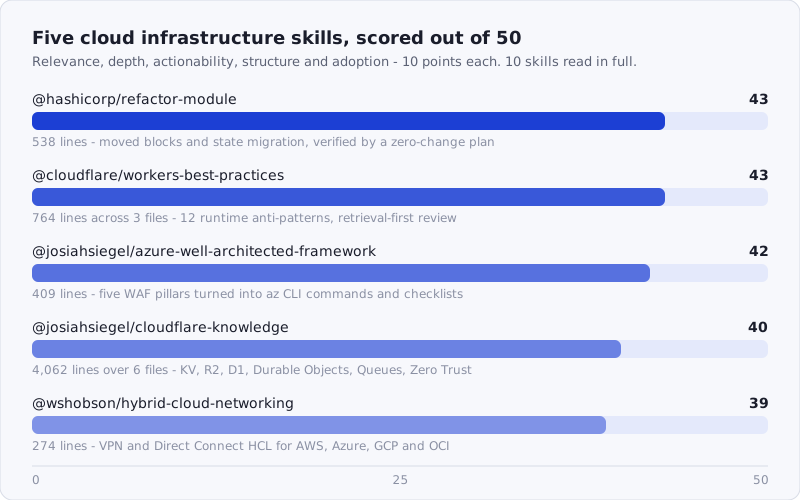
Figure: the five cloud skills that cleared the bar, scored on relevance, depth, actionability, structure and adoption.
Browse the full cloud catalog: /tags/cloud/
How We Scored
Each skill was scored across five dimensions, 0-10 each, for a maximum of 50 points:
- Relevance — Does it address real cloud infrastructure concerns (provisioning, networking, security, cost)?
- Depth — How much actual content? Specific configs, architectures, not vague advice.
- Actionability — Can a developer follow the guidance to deploy or manage cloud infra?
- Structure — Well-organized with clear cloud coverage?
- Adoption — Install count as a proxy for real-world validation.
We scored by reading the actual installed skill files — not descriptions, not README summaries. Most of the 10 candidates were either raw repo dumps with no curated structure, narrow scaffolding tools, or CI/CD skills mislabeled as infrastructure. The five below earned their scores by containing actual cloud architecture guidance — provisioning commands, cost optimization checklists, security hardening rules, and real Terraform HCL blocks you can deploy.
Where Each Skill Acts
These five do not compete with each other. Each one owns a different layer of the same deployment, which is why the install decision is “which layers do I touch?” rather than “which skill is best?”
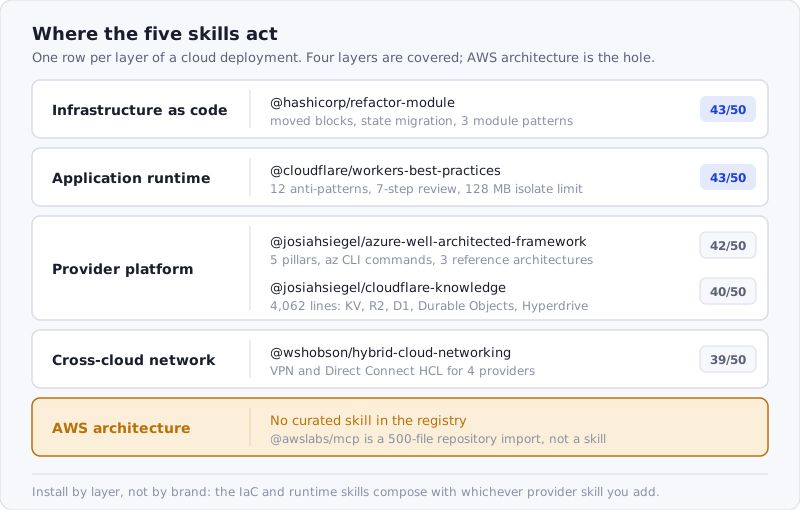
Figure: four layers covered, one hole. The IaC and runtime skills compose with whichever provider skill you add.
1. @hashicorp/refactor-module — 43/50
Score: 43/50 | Relevance: 8 · Depth: 9 · Actionability: 9 · Structure: 9 · Adoption: 8
One file, 538 lines, 7,934 installs. This is the most actionable Terraform skill in the registry — it takes a monolithic .tf configuration and walks through transforming it into a versioned, tested module with proper state migration.
The before/after code transformation is the centerpiece. The “before” section shows a monolithic main.tf with hardcoded VPC, subnet, and internet gateway resources. The “after” section shows the same resources restructured into a modules/vpc/ directory with separate main.tf, variables.tf, and outputs.tf files. Every variable gets a description, a type, and where appropriate a validation block — the CIDR block variable includes can(cidrhost(var.cidr_block, 0)) to catch invalid input before apply.
The state migration section is what earns the depth score. It covers both Terraform 1.1+ moved blocks and pre-1.1 manual terraform state mv commands. The moved block examples map each resource from its old address to the new module path, including the tricky for_each index mapping (e.g., aws_subnet.public_1 to module.vpc.aws_subnet.public["us-east-1a"]). HashiCorp’s own documentation is blunt about why this matters: a moved block exists so that Terraform “does not destroy the resource during the Terraform run.” The skill also includes the verification step most developers forget: running terraform plan after migration to confirm zero changes.
Three refactoring patterns round out the skill: Resource Grouping (networking, compute, data), Configuration Layering (base module with environment wrappers), and Composition (small focused modules wired through a root configuration). The common pitfalls section warns against over-abstraction (map(map(any)) variable types), tight coupling between modules, and the specific risk of running state migration in production before testing in a non-prod environment. If you are refactoring application code rather than HCL, the equivalent skills are in our refactoring roundup.
npx skills add https://api.skillsafe.ai/hashicorp/refactor-module2. @cloudflare/workers-best-practices — 43/50
Score: 43/50 | Relevance: 8 · Depth: 9 · Actionability: 9 · Structure: 9 · Adoption: 8
Three files totaling 764 lines: a 127-line SKILL.md, a 463-line references/rules.md, and a 174-line references/review.md. This is the official Cloudflare skill for Workers code review, and it is built around a retrieval-first philosophy — it tells the agent to fetch the latest docs rather than relying on baked-in knowledge.
The anti-pattern catalog is the strongest section. Twelve documented anti-patterns, each with an explanation of why it matters in the Workers runtime specifically. await response.text() on unbounded data risks the memory ceiling Cloudflare publishes for every isolate:
Each isolate can consume up to 128 MB of memory, including the JavaScript heap and WebAssembly allocations.
The rest of the catalog is the same shape. Math.random() for tokens is predictable — use crypto.randomUUID(). Module-level mutable variables cause cross-request data leaks because Workers instances handle multiple requests. Destructuring ctx (the execution context) loses the this binding and throws “Illegal invocation” at runtime. Direct string comparison for secrets is vulnerable to timing side-channels — use crypto.subtle.timingSafeEqual instead.
The configuration rules table covers six items that trip up most new Workers projects: setting compatibility_date, enabling nodejs_compat, running wrangler types to generate the Env interface instead of hand-writing it, using wrangler secret put instead of hardcoding, and using JSONC config format for newer features.
The review workflow in references/review.md is a seven-step process: retrieve latest types, read full files (not just diffs), check types, check config, check patterns, check security, and validate with tools (npx tsc --noEmit, lint for no-floating-promises). The emphasis on reading full files rather than diffs is practical — binding access patterns span multiple functions and a diff review misses context.
npx skills add https://api.skillsafe.ai/cloudflare/workers-best-practices3. @josiahsiegel/azure-well-architected-framework — 42/50
Score: 42/50 | Relevance: 9 · Depth: 8 · Actionability: 8 · Structure: 9 · Adoption: 8
One file, 409 lines, 6,355 installs. This skill maps all five pillars of Microsoft’s Well-Architected Framework into actionable az CLI commands and implementation checklists. It is the most structured Azure skill available.
Each pillar gets three things: principles, best practices with CLI snippets, and a deployment checklist. The Reliability pillar includes the exact availability SLA numbers (single VM with Premium SSD: 99.9%, Availability Set: 99.95%, Availability Zones: 99.99%) alongside the az vm create --zone 1 command to deploy across zones. Those tiers match what Azure documents itself: two or more VMs in an availability set are what meet the 99.95% VM SLA, and there are three availability zones per supported region. The Security pillar covers managed identities (az vm identity assign), RBAC assignments, storage encryption with TLS 1.2 enforcement, and Microsoft Defender enablement — four layers of defense-in-depth with copy-pasteable commands.
The Cost Optimization pillar is where the skill becomes particularly useful. It shows how to query Azure Advisor for cost recommendations (az advisor recommendation list --category Cost), create budget alerts at 80%, 100%, and 120% thresholds, and apply Azure Hybrid Benefit for Windows and SQL workloads. The Reserved Instances section notes savings up to 72% versus pay-as-you-go for 3-year commitments — which is the top of the range Azure itself advertises, where the published estimate spans 36% to 72% depending on the VM family and region. Treat 72% as a ceiling, not a plan.
The Common Patterns section at the bottom provides three architecture templates. The “Highly Available Web Application” pattern chains Application Gateway, App Service Premium tier, zone-redundant Azure SQL, Redis Cache, Application Insights, and Azure Front Door. The “Mission-Critical Application” pattern adds multi-region deployment with Traffic Manager and geo-redundant storage. The “Cost-Optimized Dev/Test” pattern recommends auto-shutdown, B-series burstable VMs, and Azure DevTest Labs. These patterns give the AI concrete reference architectures rather than forcing it to compose from scratch.
npx skills add https://api.skillsafe.ai/josiahsiegel/azure-well-architected-framework4. @josiahsiegel/cloudflare-knowledge — 40/50
Score: 40/50 | Relevance: 9 · Depth: 9 · Actionability: 8 · Structure: 8 · Adoption: 6
Six files totaling 4,062 lines: a 1,164-line SKILL.md and five reference files covering AI models, cost comparison, MCP server development, third-party integrations, and Zero Trust setup. This is the largest cloud infrastructure skill we evaluated by raw content.
The storage deep dives are what justify the depth score. The skill documents five storage services (KV, R2, D1, Durable Objects, Queues) with characteristics, code examples, and specific limits. KV gets propagation time (up to 60 seconds), max value size (25 MiB), and free tier limits (100K reads/day, 1K writes/day). R2 includes multipart upload code for files over 5 GB. D1 includes batch operations for transactional writes and PRAGMA optimize as a post-migration step. Durable Objects includes the WebSocket Hibernation API with the full webSocketMessage, webSocketClose, and webSocketError handler lifecycle.
The Hyperdrive section stands out for its performance explanation. It breaks down the round-trip cost: without Hyperdrive, a cold connection requires 8 round-trips (TCP handshake, TLS negotiation, DB authentication, query). With Hyperdrive, the pooled connection reduces this to 1 round-trip. The section also lists four specific cases where Hyperdrive should NOT be used — D1 databases, local development, prepared statements across requests, and Durable Objects storage.
The pricing reference table covers Workers, KV, R2, D1, Durable Objects, and Queues with both free and paid tiers. The references/cost-comparison.md file (283 lines) provides side-by-side comparisons with AWS and Azure equivalents. The scan flagged three HIGH security issues related to systemd and launchctl persistence commands in the Zero Trust setup reference, which is worth noting — those are legitimate service installation steps for cloudflared tunnels, but agents should treat them with caution. Run the source through the SkillSafe scanner and read those three findings before you install it.
npx skills add https://api.skillsafe.ai/josiahsiegel/cloudflare-knowledge5. @wshobson/hybrid-cloud-networking — 39/50
Score: 39/50 | Relevance: 9 · Depth: 7 · Actionability: 7 · Structure: 8 · Adoption: 8
Two files totaling 274 lines: a 256-line SKILL.md and an 18-line references/direct-connect.md. This is the only skill we found that covers hybrid connectivity across four cloud providers in a single file — AWS, Azure, GCP, and Oracle Cloud Infrastructure.
The skill documents two connection types per provider: VPN (lower cost, internet-dependent) and dedicated private connectivity (Direct Connect, ExpressRoute, Cloud Interconnect, FastConnect). Each VPN section includes Terraform HCL code. The AWS VPN example defines aws_vpn_gateway, aws_customer_gateway, and aws_vpn_connection resources with BGP ASN configuration. The Azure VPN example defines an azurerm_virtual_network_gateway with RouteBased VPN type and VpnGw1 SKU.
Three hybrid network patterns provide the architectural framing. Hub-and-Spoke uses Transit Gateway (AWS) or vWAN (Azure) as a central hub with production, staging, and development spokes. Multi-Region Hybrid uses dual Direct Connect links to different regions with cross-region peering. Multi-Cloud Hybrid shows a single on-premises datacenter with four simultaneous private connections to AWS, Azure, GCP, and OCI.
The High Availability section includes dual VPN tunnel Terraform code with separate customer gateways, plus guidance on active-active configuration with BGP failover and ECMP routing. The troubleshooting section provides the exact CLI commands for checking VPN status on AWS (aws ec2 describe-vpn-connections), Azure (az network vpn-connection show), and OCI (oci network ip-sec-connection list).
The skill is concise — 274 lines is lean for four cloud providers. It lacks the depth of a single-provider skill: there are no GCP Terraform examples, and the OCI sections have descriptions without code. But as the only multi-cloud networking skill in the registry, it fills a gap that no other skill addresses.
npx skills add https://api.skillsafe.ai/wshobson/hybrid-cloud-networkingFrequently Asked Questions
Which skill should I install first if I only use one cloud provider?
If you are on Azure, start with @josiahsiegel/azure-well-architected-framework (42/50) — it covers all five pillars with CLI commands and checklists. If you are on Cloudflare, install @cloudflare/workers-best-practices (43/50) for code review and @josiahsiegel/cloudflare-knowledge (40/50) for platform-wide reference. For AWS, the options are thinner: @awslabs/mcp is a 500-file repo dump of MCP servers, not a curated infrastructure skill.
What is the best Claude Code skill for Terraform?
@hashicorp/refactor-module at 43/50, with 7,934 installs. Its value is the part most Terraform guidance skips: moving existing resources without destroying them, using moved blocks on Terraform 1.1 and later, terraform state mv before that, and a terraform plan that must report zero changes as the acceptance test.
Are these skills safe to install?
Eight of the ten skills we installed scored A+ (100/100) on the SkillSafe security scan. The exception was @josiahsiegel/cloudflare-knowledge, which flagged three HIGH issues for systemd and launchctl persistence commands in its Zero Trust setup reference. Those are legitimate cloudflared service installation steps, but AI agents should confirm before executing them. Run any skill through the SkillSafe web scanner before using it in production.
Why is there no dedicated AWS infrastructure skill in the top five?
We searched for AWS-focused skills using multiple queries (“aws cloud,” “serverless lambda,” “aws cdk”). The closest match, @awslabs/mcp, is the entire awslabs/mcp GitHub repository imported as a single skill — 500 files including CI workflows, contribution guides, and 30+ MCP server source directories. It is useful as a reference repository but not as a curated infrastructure skill. @prowler-cloud/gh-aw covers GitHub Agentic Workflows for the Prowler security platform, which is CI/CD-adjacent rather than cloud infrastructure. The AWS skill ecosystem is weighted toward MCP servers and tooling rather than architectural guidance.
Do these skills work with Claude Code, Cursor, and Windsurf?
Yes. All five ship as SKILL.md files, which Claude Code, Cursor, Windsurf and other compatible runtimes read the same way — install once with npx skills add and the skill is available across tools. Two carry external dependencies rather than tool dependencies: the Terraform skill assumes the terraform CLI, and the Azure skill assumes az. Neither needs a specific editor.
Conclusion
Cloud infrastructure skills split into two categories: platform-specific depth and cross-platform breadth. The Cloudflare skills (workers-best-practices and cloudflare-knowledge) and the Azure Well-Architected Framework skill excel at depth — anti-pattern catalogs, pillar-by-pillar checklists, storage API deep dives. The Terraform refactor-module skill covers the IaC layer that sits beneath any cloud provider. And hybrid-cloud-networking is the only skill that addresses the multi-cloud connectivity problem directly.
The gap is AWS. With 6,314 installs, @awslabs/mcp has adoption, but it is a raw repository, not a curated skill. A focused AWS infrastructure skill — covering VPC design, IAM policies, cost optimization, and multi-account strategy — would immediately rank in our top five if it delivered the same density as the Azure or Cloudflare skills here. If your work is the pipeline rather than the platform, the DevOps and CI/CD roundup covers that layer.
Related roundups: Browse all Best Of roundups