What It Costs to Run an AI App on SkillSafe
A run costs the model's list price plus 10% to the platform and the creator's markup on the same base, in credits at $1 = 10,000. Worked examples inside.
A run on SkillSafe costs the model’s list price for the tokens it used, plus two equal cuts on the same base: 10% to the platform and, by default, 10% to the app’s creator. You pay in credits at $1 = 10,000, rounded up, minimum 1 credit. A default-model chat turn settles at 4 credits.
Updated September 2026: the per-job overhead was removed, so the base is now the provider’s list price and nothing else. Every other number below is unchanged.
Those base rates are the providers’ own published prices — OpenAI, Anthropic and Cloudflare Workers AI — mirrored into the model catalog. This post walks through every number, because opaque AI pricing is a choice and we made the other one.
Credits: $1 = 10,000
Credits are not a token or a points scheme — they’re dollars at a fixed denomination. One credit is $0.0001, chosen so that genuinely cheap runs can be billed exactly instead of rounding up to a whole cent. Your balance is shown in dollars, activity rows show exact costs, and cash amounts convert at the same rate in both directions.
What a Run Costs: One Base, Two Equal Cuts
Every model an app can run has a published rate on the model catalog — dollars per million input and output tokens, tracking what the provider itself charges. The arithmetic on top of it is deliberately boring:
base      = provider list cost for the tokens used (no per-job overhead)
platform  = 10% of base
creator   = the app's markup (0–100%, default 10%) of the same base
you pay   = base + platform + creator, rounded up to whole credits
Both cuts are percentages of the same base. That matters for two reasons. It means the platform’s 10% is its entire revenue on a run — there are no seat fees, listing fees, or a second cut taken out of the creator’s side. And it means an app advertising “+10%” is charging 10% of compute cost, not 10% of some already-marked-up figure.
At the default markup, the creator and the platform earn the same amount from a run. That symmetry is the point, and it’s a change from how this used to work: until July 2026 the platform billed a 1.2× multiplier on compute and then took a 10% fee out of the creator’s markup, which added up to roughly twice what the creator made. Both of those are gone.
The mechanics protect you on both sides:
- Before a run, the platform estimates the worst case and places a hold — you see the estimate before clicking run.
- The run settles at actual usage reported by the provider; the unused hold is refunded. Failed runs refund fully.
- Each run rounds up to a whole credit, minimum 1.
- If your balance can’t cover the worst case, the run scales its output cap down to your budget instead of failing.
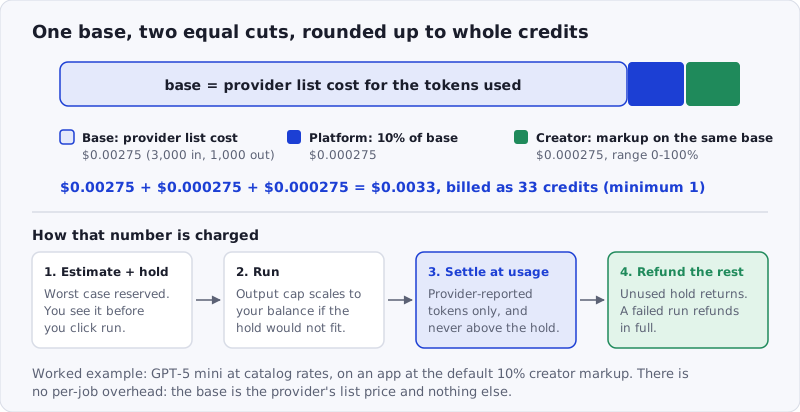
Figure: both cuts are percentages of the same base, and settlement can only ever move the charge down from the hold you were shown.
Worked Examples
Real arithmetic at current catalog rates, for a run of typical chat size, on an app at the default 10% creator markup:
| Scenario | Model | Tokens in / out | Compute | You pay | In credits | Creator earns |
|---|---|---|---|---|---|---|
| Chat turn, default model | Gemma 4 26B (Workers AI) | 1,500 / 400 | $0.00027 | ~$0.0004 | 4 | $0.000027 |
| Mid-size run, budget model | GPT-5 mini | 3,000 / 1,000 | $0.00275 | ~$0.0033 | 33 | $0.000275 |
| Premium run | Claude Sonnet 5 | 3,000 / 1,000 | $0.02400 | ~$0.0288 | 288 | $0.002400 |
All rows include whole-credit rounding, at the default 10% creator markup. Two things that table shows plainly. Model choice changes what a run costs by roughly 70× between the cheapest and the most expensive row, which is why apps declare their model on their detail page. And there is no per-job overhead: that Gemma turn is $0.00027 of inference and bills 4 credits. Until September 2026 a $0.001 per-job line item sat inside every base and was most of the price on cheap models; it was removed because the platform’s real per-run infrastructure cost is a small fraction of it.
The Creator Margin
App creators may set a markup of 0% to 100% of a run’s base cost. It’s shown on each app’s detail page (“Usage-based + N% creator margin”, with the effective per-token rate), and it’s how a skill maker earns from their work. Creators keep 100% of it — nothing is deducted. On the Sonnet 5 row above, a creator at the 100% ceiling would price that run at 504 credits ($0.0504) and keep $0.024 of it.
Creators can move that number on a slider in their app dashboard and watch what each setting pays them per run against their app’s own average run cost. The creator-side view of this math is in How to Monetize a Claude Code Skill.
Running for Free: Signup Credit, Daily Grants, Free Apps
- $0.30 signup credit for every new verified account.
- $0.20 daily grant on each day you actively use the platform.
- Free grants expire after 7 days; purchased credits and earnings never expire.
- Guests can run guest-enabled apps without an account at all.
- Apps labeled “Completely free” in the directory are verified from source to never charge usage credits, and creators can sponsor usage from their own wallet with daily caps.
At default-model prices, the signup grant alone is roughly 750 chat turns — the free tier is real.
BYOK: Flat 1-Credit Runs on the Publisher’s Own Key
Apps whose publisher attached their own Anthropic or OpenAI API key bill differently: the publisher’s key pays for inference, markup is forced to zero, and you’re charged the 1-credit minimum per run — the smallest billable unit, since there is no overhead to recover. It’s the cheapest possible lane and shows up like any other run in your activity.
Holds, Refunds, and Budget-Scaled Runs
Because settlement is capped at the pre-run hold, an app can never charge more than the estimate you saw. Since July 2026, hold/refund pairs display as a single activity row with the exact settled cost, and under-funded runs execute budget-scaled rather than throwing a 402 — both in the changelog.
Frequently Asked Questions
Why is the billed rate above the provider’s list price?
The 10% platform margin absorbs card processing — Stripe takes 2.9% + 30 cents on every top-up — plus failed-run refunds and hosting. That single cut is the platform’s entire revenue on a run: no seat fees, no listing fees, nothing taken out of the creator’s side. The creator’s markup is a separate, always-displayed cut of the same base.
How do I see what a specific app will charge me?
The app’s detail page shows its pricing lane (free, usage-based, or usage plus an N% creator margin) and its model with the effective per-token rate. Before any run, the app shows the hold estimate, and settlement can only come in at or below it. Your activity ledger shows the exact settled cost afterwards.
What happens if a run fails?
The hold is refunded in full — you are never charged for a run that did not produce output. Settlement only ever charges provider-reported usage on completed runs, capped at the hold. If your balance cannot cover the worst case, the run scales its output cap down to what you can afford instead of returning an error.
Can I buy credits without a subscription?
Yes. One-off top-ups run from $5 to $1,000 on your billing page, always in whole cents, at the same $1 = 10,000 credits rate. There is no platform seat fee for running apps. Purchased credits and earnings never expire; only the free grants do, after 7 days. Plans and team pricing are on the pricing page.
Conclusion
The whole cost model fits in one sentence: tokens used at list price, plus 10% to the platform and the creator’s markup on the same base, in credits at $1 = 10,000, rounded up, min 1, capped at the hold you saw. Every input to that sentence is public — the model catalog has the rates, app detail pages have the margins, and your activity ledger has the receipts. If you’d rather be on the earning side of it, start with turning your skill into an app.